
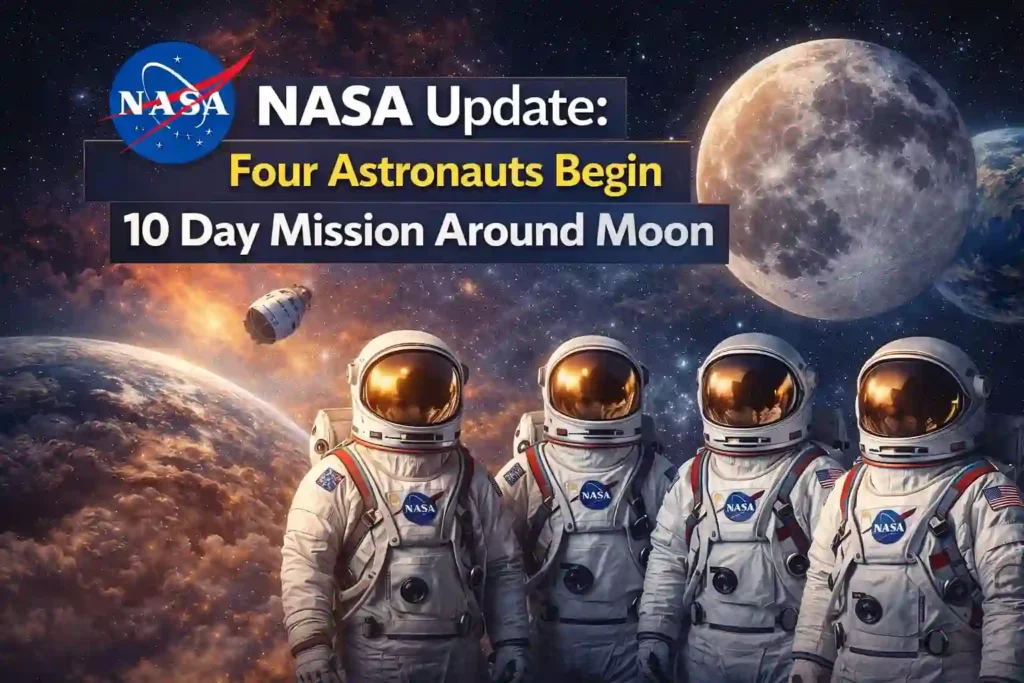
NASA Update: Four Astronauts Begin 10 Day Mission Around Moon
The latest NASA update Artemis 2 has captured global attention as four astronauts prepare to begin a historic journey around the Moon. This four astronauts Moon mission marks the first time humans will travel this far into space since the Apollo era.
Led by NASA, the mission is a major step toward returning humans to the Moon and preparing for future exploration missions. The planned 10 day Moon mission NASA will test advanced technology, crew safety, and deep space capabilities.
In this detailed post, you will find everything about the crew, mission timeline, spacecraft, objectives, and global importance.
What Is Artemis 2 Mission?
The NASA Moon mission 2026 under the Artemis program is designed to send astronauts around the Moon and safely return them to Earth.
Unlike the Apollo 11 Moon Landing, Artemis 2 will not land on the lunar surface. Instead, it will orbit the Moon and test systems with humans onboard.
This mission is a critical step before Artemis 3, which aims to land astronauts on the Moon again.

Four Astronauts Leading This Historic Mission
The four astronauts Moon mission includes a diverse and experienced crew selected by NASA.
Reid Wiseman – Commander
Reid Wiseman will lead the mission. His leadership and experience make him ideal for this historic journey.
Victor Glover – Pilot
Victor Glover will operate the spacecraft systems. He will become the first Black astronaut to travel to the Moon.
Christina Koch – Mission Specialist
Christina Koch brings valuable experience, including record-breaking time spent in space.
Jeremy Hansen – Mission Specialist
Jeremy Hansen represents the Canadian Space Agency and will be the first Canadian astronaut to participate in a Moon mission.
This crew represents the future of global space exploration.

10 Day Moon Mission NASA Timeline
The 10 day Moon mission NASA will follow a carefully planned schedule.
Mission Phases
- Launch from Kennedy Space Center
- Orbit around Earth for system checks
- Travel toward the Moon
- Lunar flyby and orbit
- Return journey to Earth
- Splashdown landing
The mission duration will be approximately 10 days, making it one of the most important short-duration deep space missions.

Spacecraft and Rocket Details
The success of the NASA update Artemis 2 depends on advanced technology.
Orion Spacecraft
The Orion spacecraft will carry astronauts safely through deep space. It includes life support systems and advanced navigation tools.
Space Launch System (SLS)
The Space Launch System is one of the most powerful rockets ever built. It will launch Orion into space and push it toward the Moon.
Both systems were successfully tested during Artemis 1.

Objectives of the Artemis 2 Mission
The NASA Moon mission 2026 has several key objectives.
Test Crew Safety
Ensuring astronauts remain safe during deep space travel.
Validate Systems
Testing navigation, communication, and onboard systems.
Life Support Testing
Checking oxygen, temperature, and health monitoring systems.
Re-entry Testing
Ensuring safe return to Earth at high speeds.
These objectives are essential for future missions.
Why This Mission Matters
The NASA update Artemis 2 is more than just a space mission.
Step Toward Moon Landing
It prepares for Artemis 3, which will land humans on the Moon.
Future Mars Missions
NASA plans to use the Moon as a base for Mars exploration.
International Cooperation
The inclusion of international astronauts shows global collaboration.
Artemis Program Overview
The Artemis program is NASA’s long-term plan for space exploration.
Major Missions
- Artemis 1 – Uncrewed test flight
- Artemis 2 – First crewed Moon mission
- Artemis 3 – Planned Moon landing
This program aims to establish a sustainable human presence on the Moon.
Challenges and Risks
The 10 day Moon mission NASA comes with several challenges.
Technical Risks
New systems must perform perfectly in deep space.
Safety Concerns
Astronaut safety is the top priority.
Mission Delays
Testing and weather conditions may affect launch timing.
NASA is carefully addressing these challenges.
Global Impact of the Mission
The NASA Moon mission 2026 will inspire people worldwide.
Scientific Growth
New discoveries and research opportunities.
Technological Innovation
Advancements that can benefit life on Earth.
Inspiration for Youth
Encouraging students to pursue science and space careers.
Future After Artemis 2
After this mission, NASA plans to move forward with Artemis 3 and beyond.
What Comes Next?
- Human landing on the Moon
- Building lunar bases
- Preparing for Mars missions
The NASA update Artemis 2 is just the beginning of a new space era.
Conclusion – NASA Update Four Astronauts Begin 10 Day Mission Around Moon
The NASA update Artemis 2 marks a historic moment as four astronauts prepare for a 10 day Moon mission NASA journey. With advanced technology, a skilled crew, and clear objectives, this mission is a major step toward the future of space exploration.
The four astronauts Moon mission will not only orbit the Moon but also pave the way for future human landings and deep space missions.
As the world watches closely, this mission reminds us that space exploration is entering a new and exciting phase.