
How Long Does It Take To Get To The Moon – NASA Artemis II Update
One of the most common questions people ask is simple: how long to get to the Moon? With the latest NASA Artemis II travel time update, this question is more relevant than ever.
The upcoming mission by NASA will send astronauts around the Moon again after decades. But how long will the journey take, and why does it take that much time?
In this detailed guide, we will explain the travel time, distance, speed, mission timeline, and how modern missions compare with older ones like Apollo.
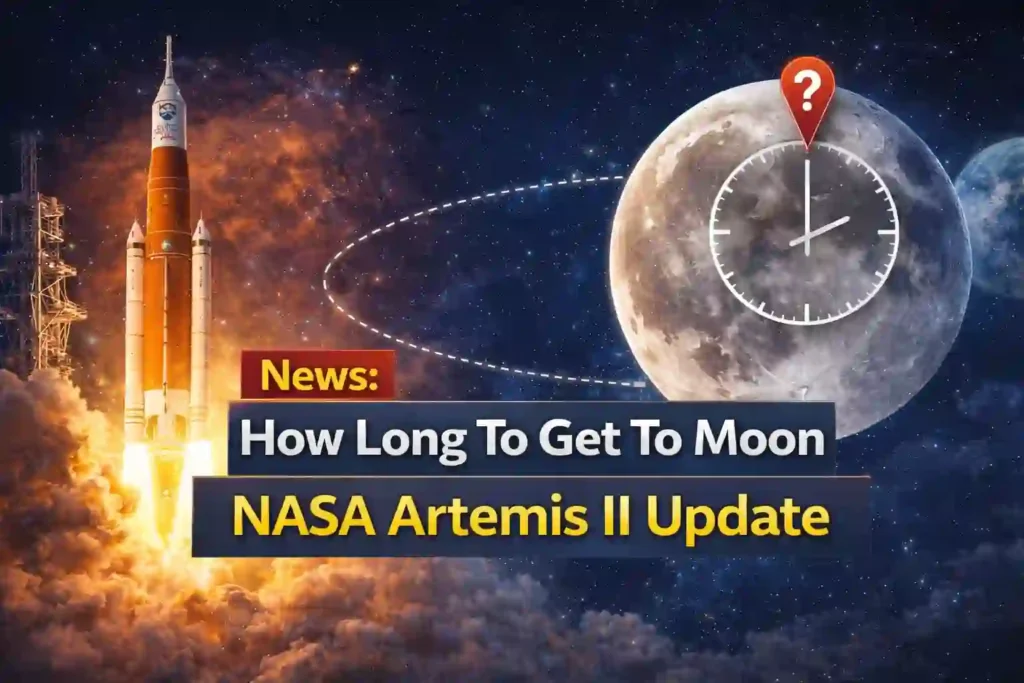
Distance Between Earth and the Moon
Before understanding how long to get to the Moon, it is important to know the distance.
The average distance between Earth and the Moon is about:
- 384,400 kilometers (238,855 miles)
However, this distance is not always the same. The Moon’s orbit is slightly elliptical, which means:
- Sometimes it is closer (perigee)
- Sometimes it is farther (apogee)
This variation can slightly affect the Earth to Moon distance time.

How Long Does It Take To Get To The Moon?
The simple answer to how long to get to the Moon is:
👉 Around 3 to 4 days
This is the typical time for spacecraft traveling at high speeds.
Why It Takes 3–4 Days
Several factors affect travel time:
- Spacecraft speed
- Flight path (direct or curved trajectory)
- Fuel efficiency
- Mission design
Modern missions like Artemis are designed for safety and precision, not just speed.

NASA Artemis II Travel Time Explained
The NASA Artemis II travel time is expected to follow a similar pattern but with slight differences due to mission design.
Artemis II is not a direct landing mission. It is a flyby mission that will orbit the Moon and return to Earth.
Estimated Timeline
- Day 1: Launch and Earth orbit
- Day 2–4: Travel toward the Moon
- Day 5–6: Lunar flyby
- Day 7–10: Return to Earth
So, the total Moon mission duration NASA for Artemis II will be around 10 days, but the travel time to reach the Moon is still about 3–4 days.

Spacecraft Used in Artemis II
The journey time also depends on the spacecraft used.
Orion Spacecraft
The Orion spacecraft is designed for deep space missions. It focuses on safety, efficiency, and long-distance travel.
Space Launch System (SLS)
The Space Launch System provides the power needed to send Orion toward the Moon.
These advanced systems ensure a smooth and controlled journey rather than the fastest possible trip.

Speed of Spacecraft Traveling to the Moon
To understand how long to get to the Moon, we need to look at speed.
Average Speed
- Around 28,000 to 40,000 km/h
This speed allows spacecraft to escape Earth’s gravity and reach the Moon.
However, speed is adjusted during the journey for navigation and safety.
Apollo vs Artemis Travel Time
A common question is how modern missions compare with older ones.
Apollo Missions
During the Apollo 11 Moon Landing, astronauts reached the Moon in about 3 days.
Artemis Missions
Artemis missions take a similar time but may be slightly longer due to:
- Safer flight paths
- More testing procedures
- Advanced mission objectives
So, the Artemis II timeline is not just about speed but also safety and research.
Why Not Travel Faster?
Many people wonder why we cannot reduce the Earth to Moon distance time.
Key Reasons
- Fuel limitations
- Heat and pressure during high-speed travel
- Need for precise navigation
- Safety of astronauts
Faster travel is possible, but it increases risks.
Mission Path and Trajectory
The path taken by the spacecraft also affects how long to get to the Moon.
Direct Path vs Curved Path
- Direct path: Faster but uses more fuel
- Curved path: Slower but more efficient
NASA often uses energy-efficient paths to ensure mission success.
Return Journey from the Moon
The return trip is also part of the Moon mission duration NASA.
After orbiting the Moon:
- The spacecraft turns back toward Earth
- Re-entry happens at very high speed
- Heat shields protect astronauts during landing
This return journey also takes about 3–4 days.
Real Challenges in Moon Travel
Traveling to the Moon is not as simple as it sounds.
Major Challenges
- Extreme temperatures
- Radiation exposure
- Communication delays
- Navigation accuracy
These challenges affect how missions are planned and how long they take.
Future Moon Travel Time
With new technology, the how long to get to the Moon question may have a different answer in the future.
Possible Improvements
- Faster propulsion systems
- Better fuel efficiency
- Advanced navigation systems
In future missions, travel time could be reduced, but safety will always remain the top priority.
Why Artemis II Is Important
The NASA Artemis II travel time mission is not just about reaching the Moon.
Key Importance
- First crewed mission in Artemis program
- Testing deep space travel with humans
- Preparing for Moon landing (Artemis III)
- Step toward Mars exploration
This mission is a major milestone in space history.
Conclusion – How Long Does It Take To Get To The Moon NASA Artemis II Update
So, how long to get to the Moon? The answer remains around 3 to 4 days, even with modern technology. The NASA Artemis II travel time follows a similar pattern but includes a full mission duration of about 10 days.
The journey to the Moon is not just about speed. It is about safety, precision, and preparation for future exploration.
As Artemis II gets closer, this mission will once again show how humans can travel beyond Earth and explore new frontiers.