Punjab Introduces New Subjects for Non-Muslim Students 2026 – Full Details
The Government of Punjab has taken a major step toward inclusive education by introducing new subjects for non-Muslim students. This initiative allows minority students to study their own religion instead of being required to take Islamic Studies or general Ethics.
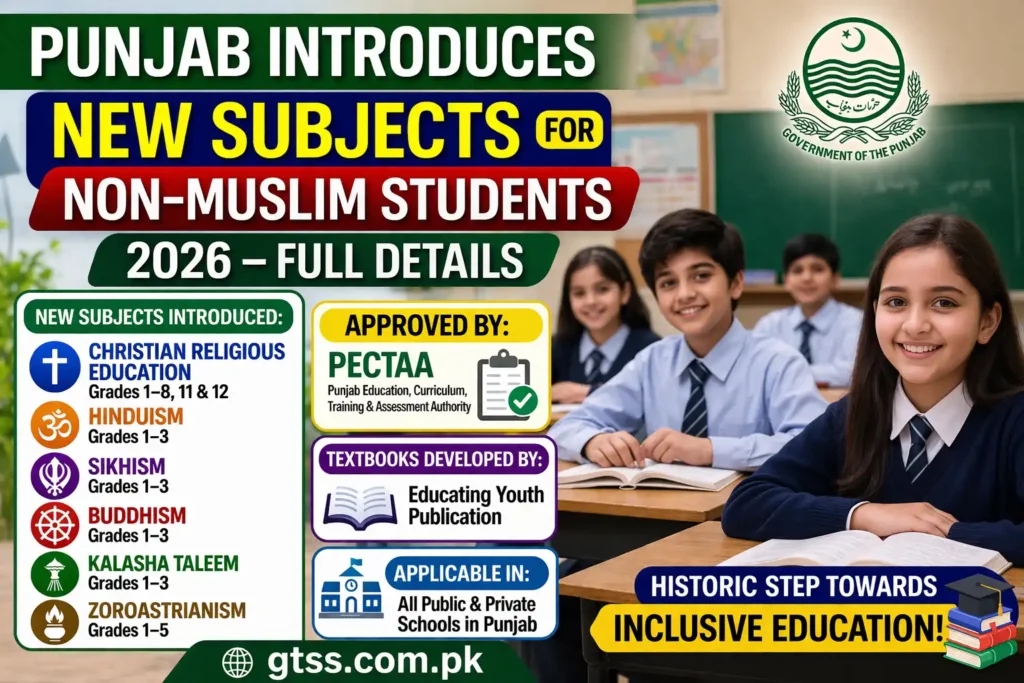
This decision has been officially approved by Punjab Education, Curriculum, Training and Assessment Authority (PECTAA) and is being implemented across schools in Punjab.
📢 What is the New Education Policy in Punjab 2026?
The new policy focuses on:
- Religious freedom in education
- Equal learning opportunities
- Respect for minority communities
Now, students belonging to different religions can study their own religious teachings in school.

📚 Which New Subjects Are Introduced?
The Punjab government has introduced multiple subjects for minority students:
✝️ Christian Religious Education
- For grades 1–8, 11 & 12
🕉️ Hinduism
- For grades 1–3
☸️ Buddhism
- For grades 1–3
🕯️ Sikhism
- For grades 1–3
🌿 Kalasha Taleem
- For grades 1–3
🔥 Zoroastrianism
- For grades 1–5
These subjects are designed according to each religion’s teachings.

🏫 Who Approved These Subjects?
The curriculum and textbooks were approved by:
👉 Punjab Education, Curriculum, Training and Assessment Authority (PECTAA)
This ensures:
- Proper curriculum standards
- Quality education
- Government supervision

📖 Who Developed the Textbooks?
The textbooks for Christian Religious Education were developed by:
- Educating Youth Publication
These books are specially designed for minority students.
🏛️ Where Will These Subjects Be Taught?
The new subjects will be implemented in:
- Public schools
- Private schools
Across all regions of Punjab.
⚖️ Why This Decision is Important
This decision is considered historic because:
- It promotes religious freedom
- Supports minority rights
- Improves education quality
Students will now feel more connected to their beliefs.
🌍 Concept of Inclusive Education
Inclusive education means:
👉 Equal opportunities for all students regardless of religion
This policy helps:
- Reduce discrimination
- Promote harmony
- Build respect among communities
👨🎓 Benefits for Non-Muslim Students
Key Advantages:
- Study their own religion
- Better understanding of beliefs
- Improved confidence
👩🏫 Impact on Teachers & Schools
Schools will need to:
- Hire trained teachers
- Update curriculum
- Provide new textbooks
📊 Comparison with Old System
Old System:
- Islamic Studies compulsory
- Ethics as alternative
New System:
- Religion-based subjects available
- More personalized education
⚠️ Challenges in Implementation
Despite benefits, some challenges may arise:
- Lack of trained teachers
- Resource availability
- Curriculum standardization
🧠 Public Reaction
Many people have appreciated this step:
Positive Feedback:
- “Great step for minorities”
- “Promotes equality”
However, some concerns exist about implementation.
📈 Long-Term Impact
This policy can lead to:
- Better social harmony
- Increased educational engagement
- Stronger minority inclusion
🇵🇰 Role of Punjab Government
Punjab government aims to:
- Improve education system
- Ensure equality
- Promote unity
🔮 Future of Education in Pakistan
Experts believe:
- More inclusive policies may come
- Education reforms will continue
- Minority rights will strengthen
📝 Conclusion
The introduction of new subjects for non-Muslim students in Punjab is a major educational reform. It promotes equality, respect, and inclusion in society.
This step shows that Pakistan is moving toward a more inclusive and fair education system.